


When Pain Outlasts the Original Injury
Central Sensitization Pasadena is an important topic for people living with chronic pain that continues long after an injury has healed. Conditions such as fibromyalgia, CRPS, neuropathy, and chronic migraine may involve changes in the nervous system that keep pain signals active even when tissue healing has occurred.
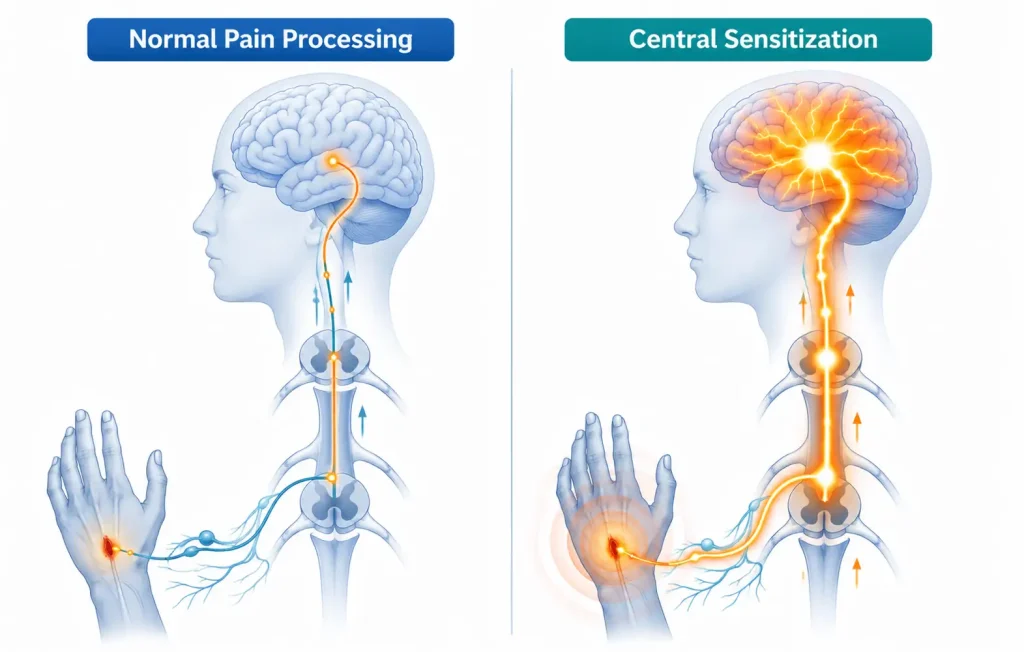
This is often described as central sensitization. It is not “pain in your head” in the dismissive sense. It means the central nervous system—especially the brain and spinal cord—has become more sensitive to pain signals. Normal sensations may feel painful, mild pain may feel severe, and symptoms may spread or persist long after the initial injury.
At SoCal Infusions, many patients seeking advanced infusion care have symptoms that may involve central sensitization: chronic pain, fibromyalgia, neuropathic pain, CRPS, migraine, PTSD-related body tension, and mood symptoms that worsen as pain becomes exhausting. Understanding central sensitization can help patients see why chronic pain often needs a nervous-system-focused approach.
What Is Central Sensitization Pasadena?
Central sensitization is a process where the central nervous system becomes more reactive to sensory input. In a healthy pain response, the nervous system turns pain volume up when protection is needed and turns it down as healing occurs. With central sensitization, the volume stays turned up.
This can affect how the body interprets pressure, temperature, movement, stress, sleep disruption, and emotional strain. Signals that would normally feel mild or manageable may be processed as threatening or painful.
A simple way to think about it:
– Acute pain is like a smoke alarm responding to real smoke.
– Central sensitization is like a smoke alarm that has become too sensitive and goes off when toast is slightly warm.
The alarm is real. The distress is real. But the problem may be in the sensitivity of the system, not ongoing tissue damage alone.
Understanding Central Sensitization Pasadena can help patients better recognize why chronic pain may continue despite normal imaging or completed healing.
Symptoms That May Suggest Central Sensitization
Central sensitization can look different from person to person. Some patients experience widespread pain, while others have pain concentrated in one region. Many also notice fatigue, sleep problems, brain fog, and sensitivity to stress.
Common features may include:
- Pain that lasts longer than expected after an injury.
- Pain that spreads beyond the original area.
- Sensitivity to touch, pressure, light, sound, or temperature.
- Flares triggered by stress, poor sleep, or overexertion.
- Pain that feels disproportionate to imaging or test findings.
- Burning, aching, electric, or deep body pain.
- Fatigue and difficulty recovering after activity.
- Brain fog or difficulty concentrating.
- Anxiety or depression connected to living with ongoing pain.
These symptoms can be frustrating because patients may be told that scans look normal or that the original injury has healed. Central sensitization helps explain how pain can remain real even when routine tests do not show a clear new injury.
Conditions Often Linked With Sensitized Pain Pathways
Central sensitization may play a role in several chronic pain and neurological conditions. It does not mean every patient has the same diagnosis, but it helps explain why certain conditions often overlap.
Examples include:
– Fibromyalgia.
– Complex regional pain syndrome, also known as CRPS.
– Chronic migraine.
– Neuropathic pain.
– Chronic back or neck pain.
– Temporomandibular joint pain.
– Irritable bowel syndrome.
– Chronic fatigue patterns.
– PTSD-related body tension and hyperarousal.
For some patients, central sensitization becomes part of a larger cycle: pain disrupts sleep, poor sleep increases sensitivity, increased sensitivity worsens pain, and pain then increases anxiety or depression. Breaking this cycle often requires more than one intervention.
Why Standard Pain Treatments May Not Be Enough
Traditional pain care often focuses on the site of pain: the joint, disc, muscle, nerve, or injured tissue. That approach is important, especially when there is active injury, inflammation, compression, or structural disease. But when central sensitization is a major factor, treating only the local pain site may not fully resolve symptoms.
Patients may have already tried:
- Anti-inflammatory medications.
- Muscle relaxers.
- Physical therapy.
- Steroid injections.
- Surgery.
- Nerve blocks.
- Opioid or non-opioid pain medications.
- Chiropractic or massage therapy.
- Supplements and lifestyle changes.
Some of these may help, but sensitized pain pathways can remain active. In these cases, care may need to focus on calming the nervous system, improving sleep, reducing fear around movement, addressing mood symptoms, and using treatments that affect pain processing at the central level.
How Ketamine May Fit Into Chronic Pain Care
Ketamine is an NMDA receptor antagonist. NMDA receptors are involved in pain signaling, learning, memory, and nervous system plasticity. In certain chronic pain conditions, NMDA receptor activity may contribute to wind-up, sensitization, and persistent pain signaling.
Ketamine infusion therapy may be considered for selected patients with chronic pain conditions such as CRPS, neuropathic pain, fibromyalgia, or other refractory pain syndromes. The goal is not simply to numb the body. Instead, ketamine may influence pain processing and central sensitization pathways in ways that differ from standard pain medications.
Ketamine is not appropriate for every patient, and results vary. It requires careful screening, medical supervision, and realistic expectations. It is usually considered when symptoms are significant and other treatment approaches have not provided enough relief.
The Role of Sleep, Stress, and Mood
Central sensitization is strongly affected by the state of the nervous system. Poor sleep, chronic stress, trauma, anxiety, and depression can all increase pain sensitivity. This does not mean pain is imaginary. It means the pain system is connected to the whole person.
For example:
– Poor sleep lowers pain tolerance.
– Stress increases muscle tension and sympathetic activation.
– Depression can reduce motivation and activity, worsening deconditioning.
– Anxiety can increase vigilance toward body sensations.
– Trauma can keep the body in a protective fight-or-flight state.
A comprehensive pain plan should address these factors. Patients often need a combination of medical care, movement support, nervous system regulation, mental health support, sleep improvement, and carefully selected treatments.
What Patients Can Do to Support Nervous System Recovery
Central sensitization can improve, but progress is often gradual. The goal is to help the nervous system relearn safety and reduce overreactivity.
Helpful strategies may include:
– Gentle, paced movement instead of boom-and-bust activity.
– Consistent sleep routines.
– Stress reduction practices such as breathwork or mindfulness.
– Working with a therapist familiar with chronic pain or trauma.
– Avoiding overexertion during pain flares.
– Tracking triggers without becoming fearful of every symptom.
– Building a care team that understands nervous-system-based pain.
– Considering advanced treatments when appropriate.
Patients should avoid interpreting central sensitization as a personal failure. It is a physiological process, and it deserves serious care.
How SoCal Infusions Approaches Chronic Pain
SoCal Infusions evaluates chronic pain through a whole-nervous-system lens. Patients may come in with a diagnosis such as fibromyalgia, CRPS, neuropathy, migraine, or chronic pain syndrome, but the care team also looks at symptom patterns, treatment history, sleep, stress, mood, and functional impact.
The clinical approach may include:
- Careful consultation and medical history review.
- Discussion of prior pain treatments and response.
- Screening for ketamine suitability when appropriate.
- Education about what infusion therapy can and cannot do.
- Coordination with referring providers when helpful.
- A calm clinical environment for treatment.
- Clear aftercare and follow-up expectations.
Learning about Central Sensitization Pasadena empowers patients to have informed discussions with their healthcare providers about appropriate treatment options.
FAQ: Central Sensitization and Chronic Pain
No. Fibromyalgia is one condition often associated with central sensitization, but central sensitization can also be involved in other chronic pain conditions.
No. It means the nervous system may be amplifying pain signals. Patients can have both tissue-related pain and central sensitization at the same time.
Yes, many patients improve with a comprehensive plan that addresses movement, sleep, stress, mental health, pain processing, and appropriate medical treatment.
Ketamine is not a guaranteed cure. It may be considered for selected patients with refractory pain, especially when central pain processing appears to play a role.
No treatment changes should be made without your healthcare provider. Infusion therapy is often part of a broader care plan.
Understanding Central Sensitization Pasadena
Central sensitization helps explain why chronic pain can persist, spread, or flare even when the original injury is no longer the whole story. For patients who have felt dismissed or confused by normal test results, this framework can be validating: the pain is real, and the nervous system may need targeted support.
At SoCal Infusions, chronic pain care is approached with respect for the complexity of the nervous system. For selected patients, ketamine infusion therapy may be one tool within a larger strategy to reduce pain sensitivity and support better function.
If chronic pain, fibromyalgia, neuropathy, CRPS, or migraine symptoms are limiting your life, schedule a consultation with SoCal Infusions to learn whether infusion-based care may be appropriate for your situation.
This article is for educational purposes only and is not medical advice. Chronic pain can have many causes, including urgent or progressive conditions. Seek immediate medical care for sudden weakness, loss of bowel or bladder control, chest pain, severe new headache, fever with severe pain, or rapidly worsening neurological symptoms.